Ibrahim Arif
The Thursday Murder ClubIbrahim Arif brings the habits of a psychiatrist and the pleasures of a meticulous problem-solver to the Thursday Murder Club. He joins Elizabeth, Penny Gray, and Ron Ritchie in investigating old cases and, when Tony Curran is found dead, takes charge of a new inquiry. His analytical discipline is often played for humor, but it has practical force: he calculates routes, organizes suspects, and tests explanations. Just as important, he sees Coopers Chase not simply as a place to live but as a community whose everyday company helps people bear change, grief, and time.
Identity and Background
Ibrahim is a psychiatrist, though the narration jokingly leaves open whether he still practices. Penny Gray had played bridge with him before he joined the club, and he had already helped Elizabeth and Penny with occasional tasks. He no longer plays bridge, a change the narrator regards as a shame. His professional background is not presented as a formal credential for solving crimes so much as part of the way he observes people: his manner can initially conceal it, but familiarity makes the connection seem apt.
His curiosity also has a distinctly practical, almost comic cast. In conversation, he imagines that he would have made a good heroin smuggler, dwelling on the logistics, the precision of weighing, and the machines used to count money. The remark is a fanciful exercise in applied problem-solving, not an account of criminal activity. It shows how readily his mind turns an unlikely subject into a system of processes to examine.
The Thursday Murder Club
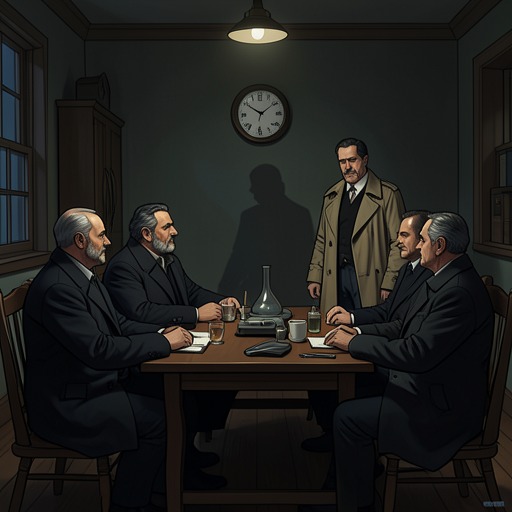
The club’s Thursday schedule is shaped by the ordinary arrangements of Coopers Chase. Its members meet during a two-hour opening in the Jigsaw Room between other activities. The room is booked under the name Japanese Opera – A Discussion, a cover that lets the group work without interruption. Ibrahim joins after Elizabeth and Penny have established the meetings, bringing prior familiarity with Penny and a record of helping them with their inquiries.
The club’s reach depends on more than its four regular members. Elizabeth and Penny can call in favors, and people with varied expertise—including forensic officers, accountants, judges, tree surgeons, horse-breeders, and glass-blowers—have been invited to discuss questions the club is pursuing. Ibrahim belongs to this informal network of knowledge and assistance. Ron’s arrival is less planned: suspicious of the supposed Japanese opera, he enters the Jigsaw Room to find out what is happening. Elizabeth gives him a file concerning a scoutmaster found burned to death in 1982, and recognizes that his refusal to take anyone’s account at face value is useful to the investigations. Ibrahim’s own contribution complements that skepticism with analysis and structure.
Method and Investigative Work
When Elizabeth learns that Tony Curran has been found dead in his kitchen, she puts Ibrahim in charge of a task shared with Ron. The news has reached her through a chain of people: Ron heard it from his son Jason, who had heard it from a source not yet documented. The club’s first understanding of the case thus arrives through an informal network rather than an official briefing. Ibrahim’s role is to turn that uncertain beginning into organized inquiry.
His method favors measurements and explicit calculations. To test the journey between Coopers Chase and Tony Curran’s house, the group uses Ron’s Daihatsu. Ron is the only one with a car, but Ibrahim becomes the driver because he is the only one who understands the satnav. Joyce has not held a licence for thirty years; Ron has lost confidence making right turns; and Elizabeth, despite holding a valid tank licence, does not prevail in the argument over who should drive. The small domestic negotiations give way to the practical task: the group knows Ian Ventham left Coopers Chase at 3 p.m. and that Tony was murdered at 3:32 p.m., so the journey time matters. Ibrahim wants to take the car to Tony’s gate for exactness, but Elizabeth points out that this would be poor fieldcraft. From a lay-by about 300 metres away, he records the result: thirty-seven minutes at an average speed of twenty-seven and a half miles per hour, with no traffic on the route he selected.
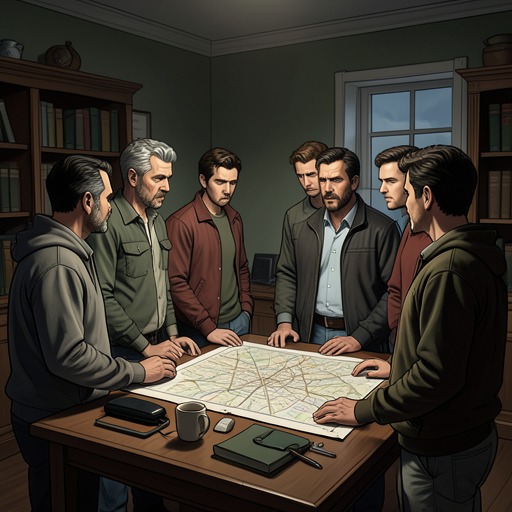
Ibrahim also helps turn a crowd into a set of investigable possibilities after Ian Ventham’s death. At Elizabeth’s request, he prepares calculations and asks the others to list the people they remember seeing. He reasons from the puncture wound on Ventham’s upper arm and the apparent speed of the fatal injection: someone in the crowd must have administered it, and Ventham was almost certainly dead within a minute. The resulting lists are not all arranged as neatly as he requested, but the method produces a starting point. Later, Elizabeth identifies Ibrahim’s spreadsheet of thirty names as the basis for the inquiry into who might have killed Ventham.
Relationships and Community
Ibrahim’s relationships extend beyond the club’s formal work. Elizabeth is willing to entrust him with responsibility, and he accepts her appointment with evident confidence. Ron is his fellow investigator and, on the drive to Tony Curran’s house, his companion in a practical division of labor. Ibrahim drives while Ron, Joyce, and Elizabeth travel with him; the investigative outing retains the texture of a shared trip, complete with instructions about everyone using the toilet before departure and Joyce offering snacks.
His connection with Penny is quieter and more personal than Elizabeth first realizes. During a visit, Elizabeth observes that Ibrahim does not seem to come and see Penny; John Gray corrects her, saying that he does. The revelation surprises Elizabeth, but confirms that Ibrahim has maintained a private connection with Penny even when it has not been visible to her. It also distinguishes his care from the public work of the club: not every relationship or act of attention is announced to the group.
Ibrahim’s sense of community is stated most fully in his reflections on Coopers Chase. He values its committees and politics, its arguments, gossip, and fun, as well as the repeated arrival of new residents and the farewells that remind everyone the place cannot remain unchanged. In his view, community makes companionship available without making solitude impossible: a resident can close a front door to be alone or open it to be with others. He connects that everyday structure of belonging to the needs of older people, especially Bernard Cottle, who has lost his wife and shows no sign of finding a way through his grief. Bernard’s need for quiet at Fairhaven Pier or on a hilltop bench is not something others need to interrogate. Ibrahim recognizes that a community can offer company while also respecting the places where grief is borne alone.
Judgment, Change, and Narrative Role
Ibrahim’s precision does not make him emotionally detached. When Joyce reads Bernard Cottle’s account of keeping Asima’s ashes instead of sending them to the Ganges, Ibrahim sits forward and responds with surprise. The letter explains that Bernard substituted sawdust and bone meal in the urn and kept the real ashes in a tiger-shaped tea caddy, a keepsake connected to the private names he and Asima shared. Ibrahim’s reaction is brief, but it registers the force of the disclosure: beneath his orderly investigative habits, he is attentive to the intimate human history that a clue may uncover.
That balance of reason and feeling is especially clear when the club confronts John Gray about Ian Ventham’s murder. Ibrahim challenges John’s claim that he committed the killing simply to save himself. He acknowledges that John regards the act as unforgivable, then argues that the explanation does not fit what the group understands of him. Joyce names love as the motive. Ibrahim’s contribution is not merely to identify a contradiction; he helps articulate why the contradiction points toward a deeper attachment. The scene shows the investigative group using psychological judgment alongside physical evidence and calculation.
Near the end of the case, Ibrahim returns with the final piece of the puzzle. Elizabeth has already received the photograph Karen Playfair recognized and worked through the implications step by step; Ibrahim’s return completes the sequence in her mind. The evidence supplied here does not specify what he brought, but it establishes the consequence: Elizabeth concludes that the case is solved and that only justice remains. Ibrahim is therefore both an independent reasoner and part of a collaborative method in which a final fact can confirm a conclusion assembled by others.
His portrayal joins exactness to fellowship. The man who calculates a journey to the minute, files away an algorithm about the swimming pool’s opening hours, and asks for orderly lists also values the untidy social life of Coopers Chase. His work in the club gives that community another purpose: its conversations, favors, personal histories, and overlapping connections become resources for inquiry. Yet the investigations do not exhaust his importance. Ibrahim notices that people need different forms of peace, keeps connections that others may overlook, and treats companionship as one of the ordinary structures by which a community stays alive.